
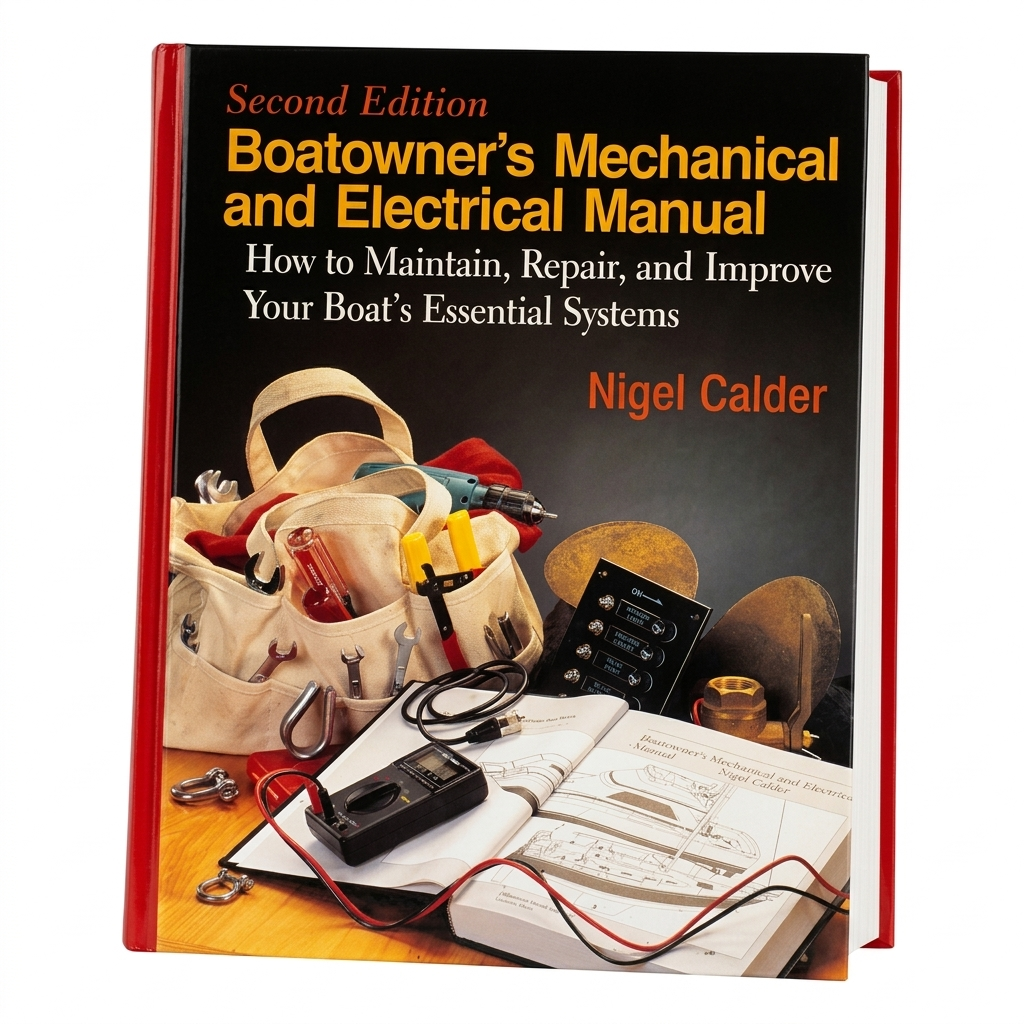
Boatowner's Mechanical and Electrical Manual
NZ$49.95
Boatowner's Mechanical and Electrical Manual
By Nigel Calder
Historical Significance
Nigel Calder’s Boatowner's Mechanical and Electrical Manual is widely considered the quintessential contemporary reference for marine systems. Since its initial publication, it has achieved a status in maritime literature comparable to the great navigational texts of the past, serving as the definitive "systems bible" for the modern cruising sailor. Calder, a highly respected marine researcher and engineer, fundamentally changed the landscape of yacht ownership by demystifying the complex interplay between mechanical propulsion and sophisticated electrical grids.
The work is a rigorous technical compendium that addresses the shift from simple, self-contained mechanical vessels to the integrated, electronically-governed yachts of the late 20th and early 21st centuries. Its significance lies in its uncompromising depth; Calder does not merely explain how to repair a system, but provides the underlying engineering principles of why a system is designed as it is. For the maritime historian or technical collector, this manual documents the evolution of marine technology—from lead-acid battery banks and naturally aspirated diesels to lithium-ion storage and NMEA 2000 networking. It is an essential cornerstone for any library dedicated to the practical realities of self-sufficiency at sea.
Key Maritime Themes
Marine Engineering: Comprehensive analysis of small-craft diesel engines, cooling systems, and transmission mechanics.
Electrical Theory and Practice: Detailed schematics for DC and AC circuits, battery management, and lightning protection.
Naval Systems Integration: The study of how disparate systems—pumps, refrigeration, and electronics—function within a corrosive marine environment.
Corrosion Science: Technical insights into galvanic and electrolytic corrosion and the selection of maritime alloys.
Renewable Energy at Sea: Practical engineering for wind, solar, and hydro-generation in a cruising context.
Geographic Relevance
For the New Zealand mariner, this volume is a non-negotiable asset. Given the isolated nature of New Zealand’s coastal waters and the long-range blue-water passages common to South Pacific cruisers, the ability to perform complex mid-ocean repairs is a vital safety requirement. Calder’s emphasis on "self-sufficiency" resonates deeply with the New Zealand seafaring tradition, where help is often days away. Whether navigating the Hauraki Gulf or embarking on a passage to Fiji, this manual provides the technical backbone for safe and informed vessel management in the challenging conditions of the Southern Hemisphere.
Condition
Used hardback in very good condition. No dust jacket. Published in 1996. 592 Pages.