
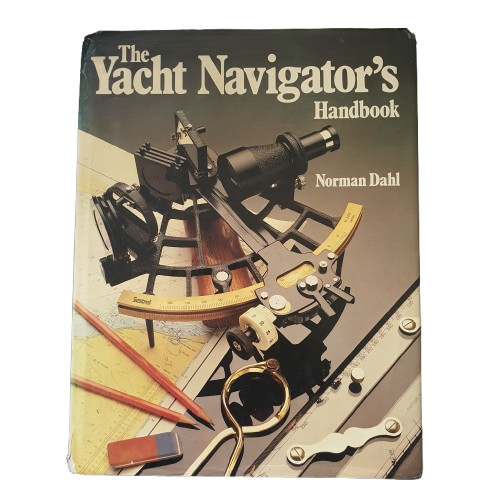
The Yacht Navigator's Handbook
NZ$39.95
The Yacht Navigator's Handbook
By Norman Dahl
Historical Significance
Norman Dahl’s The Yacht Navigator's Handbook represents a critical milestone in the pedagogical literature of maritime navigation. Published during the late 20th-century transition from traditional terrestrial and celestial methods to early electronic positioning systems, Dahl’s work served as a primary text for the Royal Yachting Association (RYA) and various international maritime academies. As an experienced navigation instructor, Dahl was instrumental in codifying the "logic of the plot," ensuring that the arrival of electronic aids did not erode the foundational discipline of manual dead reckoning.
The text is historically significant for its rigorous treatment of the "interim" era of navigation—a period when Decca, Loran-C, and early satellite-derived coordinates were beginning to complement, but not yet replace, the sextant and the hand-bearing compass. For the maritime collector, this volume documents the evolution of chartroom practices before the total ubiquity of the Chart Plotter and GNSS. It remains a vital addition to a nautical library as a comprehensive record of the analytical skills required to navigate safely when electronic systems are compromised or unavailable.
Key Maritime Themes
Terrestrial Navigation: Meticulous instruction on fixing positions using land-based bearings, transit lines, and clearing marks.
The Physics of Tides: Advanced calculation of tidal heights and streams using secondary port data and interpolation.
Dead Reckoning and Estimated Positions: The mathematical discipline of accounting for leeway, set, and drift in a sailing vessel.
Early Electronic Aids: Technical overviews of radio direction finding (RDF) and pulse-based hyperbolic navigation systems.
Chartwork and Instrumentation: The correct application of the parallel rule, dividers, and the maintenance of the formal logbook.
Geographic Relevance
For the New Zealand mariner, Dahl’s emphasis on "traditional self-reliance" is particularly pertinent. Given the rugged nature of the NZ coastline and the potential for electronic interference in isolated sounds or high-latitude passages, the manual skills detailed in this handbook remain a cornerstone of local seamanship. The work has historically informed the training of many New Zealand offshore sailors, providing the theoretical framework necessary for navigating the vast and often under-surveyed waters of the South Pacific and the Southern Ocean.
Condition
Used hardback in good condition. Dust jacket has some miner tears on edges. The cover has some fading. Inscription inside front cover. Published in 1983. 200 pages.